Inclusive Prosperity
Inclusive prosperity is about whether economic systems are ethical, adaptive, and capable of generating opportunities across identities, income levels, and life stages. Odenton’s proximity to Fort Meade, access to Washington D.C. and Baltimore via MARC train, and steady residential growth contribute to its fairly strong economy. For prosperity to be inclusive, growth must translate into equal opportunity for all residents.
Corporate Prioritization
Much of the Odenton Town Center (OTC) redevelopment plan appears oriented toward attracting regional traffic and non-resident consumers. While mixed-use development and commercial expansion can stimulate tax revenue and economic density, many residents perceive these initiatives as favoring large corporations over small, local businesses.
Recent construction and permitting requests reflect this concern. Developers are prioritizing established brands such as Sprouts, Wawa, and Taco Bell rather than local businesses. From a financial perspective, these type of tenants reduce investment risk and provide predictable returns. However, from a community perspective, this approach raises concerns over higher lease rates, fewer paths for local ownership, and profits leaving the community. Livable cities require balancing financial stability with local opportunity for economic prosperity.
Income Sources and Economic Stability:
Odenton’s economy is strongly connected to employment at Fort Meade (defense, cybersecurity, federal contracting) and commuter access to Baltimore, Annapolis, and Washington, D.C.
These income sources provide economic stability and higher than average median household earnings. However, a large commuting workforce shifts daytime economic activity outside the community. This could be the reason behind a lack of locally owned restaurants.
While Odenton maintains a stable retail footprint with grocery stores, a variety of service providers, and national chains, much of it reflects convenience retail, highlighting Odenton’s lack of diversity in its commerce. For prosperity to feel shared, more people need to be able to participate in it.

School Redistricting:
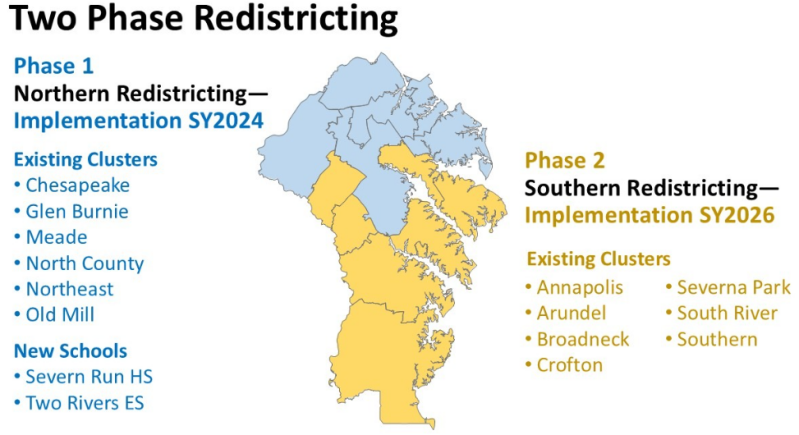
Anne Arundel County Public Schools (AACPS) recently began a comprehensive school redistricting process in response to shifting enrollment patterns, new housing developments (including Two Rivers and areas around Odenton Town Center), and school overcrowding. Their goal is to better balance student populations and align boundaries with projected growth.
Redistricting has generated significant public concern. In Odenton, school reputation strongly influences housing demand and neighborhood desirability. About one-quarter of Odenton residents feed into Meade High School (MSDR rating 51.1%), while the majority attend Arundel High School (63.8%). Other rating systems show similar disparities between the two schools. The proposed redistricting would shift students from Arundel High School to Meade High School.
Some residents believe that test scores may be shaping redistricting outcomes. One resident felt that students from higher-rated schools were being reassigned to lower-performing schools in order to boost overall school ratings. According to the AACPS's restricting proposal, that is not a factor, but this controversy highlights distrust between residents and public institutions.
Many parents make significant financial decisions based on school assignments, making these boundary changes affect not only educational decisions but economic ones as well. When school performance varies, redistricting can be perceived as redistributing opportunity unevenly.
Public briefings in 2025 led to modifications of the final plan, but in a community with a high concentration of transient military families, not all residents were positioned to respond or adjust housing plans in time. Some families have even considered homeschooling or private education as a result.
Redistricting has direct impacts on shared prosperity. School boundaries can either reinforce or mitigate economic stratification across neighborhoods, shaping where families of varying incomes can realistically live and access high-quality education.